
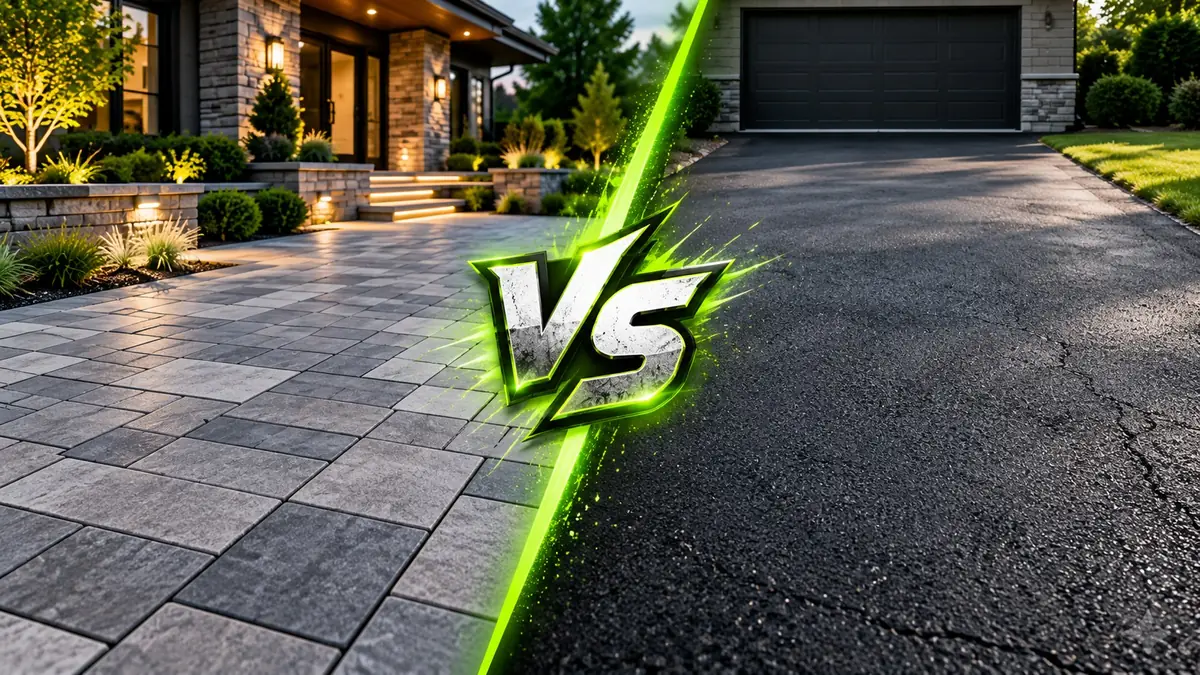
Asphalt and interlocking pavers are the two most common driveway choices around Montréal. Asphalt wins on upfront price. Pavers win on almost everything that happens after the first winter. Which one is right for you depends on how long you plan to stay in your home and what you want your driveway to look like in ten years.
The short answer
| Asphalt | Pavers | |
|---|---|---|
| Upfront cost | Lower | Higher |
| Installation time | Faster | Longer, laid by hand |
| Freeze-thaw | Rigid surface, cracks as the ground moves | Flexible joints move with the ground without cracking |
| Regular upkeep | Sealing every few years, crack filling | Occasional joint sand top-up |
| Repairs | Patches that rarely match | Lift and reset or replace the affected stones |
| Lifespan | Resurfacing or replacement usually within 10 to 20 years | Several decades on a properly built base |
| Look | Black, fades to grey | Many colours, sizes, textures and patterns |
Upfront cost vs. lifetime cost
Asphalt costs less to install. The material is cheaper and it goes down quickly by machine, while pavers are placed one by one and usually need deeper excavation. If the only number that matters is the price on day one, asphalt wins.
The picture changes over time. An asphalt driveway needs sealing every two to three years to stay in good shape, cracks need filling as they appear, and most need resurfacing or replacing somewhere between 10 and 20 years in our climate. A paver driveway built on a good base mostly needs an occasional top-up of joint sand. Spread over the years you own your home, the gap between the two gets much smaller, and for many homeowners pavers end up costing less.
How each one handles a Montréal winter
This is where the difference is biggest. Asphalt is one continuous, rigid slab. When water gets into small surface cracks and freezes, it expands and widens them. The ground underneath also shifts through the winter, and a rigid slab can’t follow it, so it cracks. By spring, small cracks turn into broken edges and potholes.
A paver driveway is made of hundreds of individual units separated by joints. When the ground moves slightly, the pavers move with it instead of breaking. Built on a drained, open-graded base, water also passes through the joints and drains away instead of sitting under the surface and freezing. Read more in our guide to why an open-graded base stops heaving and settling.
To be fair to asphalt, its dark surface absorbs sunlight and helps snow melt a little faster on a sunny day. That advantage fades quickly once the surface is cracked and water starts pooling in low spots, which is also where ice forms.
Snow removal and de-icing salt
Quality concrete pavers are made to handle shovels, snow blowers, plows and de-icing salt. We recommend a plow or snow blower with a rubber or poly edge, or skids set slightly above the surface, to protect the paver edges. Avoid de-icers that contain ammonium, which can damage concrete over time. Regular rock salt or calcium chloride is fine on quality pavers.
Asphalt tolerates plowing well when it’s new, but salt, water and freeze-thaw together speed up the breakdown of the surface, especially once it has started to crack.
Repairs: patches vs. individual stones
When asphalt cracks or sinks, the fix is a patch or a new layer on top. Patches almost never match the colour of the original surface, so repairs stay visible for years.
With pavers, a damaged or stained section can be lifted, the base underneath corrected, and the same stones reset or replaced. Once the joints are filled, the repair disappears. The same goes for utility work: if a line under the driveway ever has to be dug up, the pavers go back in afterwards.
Curb appeal and resale
Asphalt comes in one colour, and it fades from black to grey within a few years. Pavers come in a wide range of colours, sizes, finishes and patterns, and borders and inlays can be designed around your home. We use Techo-Bloc for all our paver projects and show you the options in a 3D render before anything is built.
A driveway is one of the first things people see. A clean paver driveway reads as a premium feature and adds to the curb appeal buyers notice when you sell.
When asphalt makes sense
Asphalt can be the right choice if you’re selling in the next few years, have a very long rural driveway where cost per square foot matters most, or need the lowest possible price right now. If you plan to stay in your home for the long run and want a driveway that still looks good in ten or fifteen years, pavers are usually the better investment.
What makes a paver driveway last
Pavers are only as good as what’s underneath them. The biggest reasons paver driveways fail are shallow digging, a dense base that holds water, and weak edges. On every driveway we:
- Excavate 12 to 18 inches, down to stable ground
- Lay geotextile fabric over compacted soil
- Build 8 to 14 inches of compacted 3/4 in clear stone, with a 1 in bed of 1/8 in clear stone
- Set Techo-Bloc pavers with Alliance Gator resin-based joint sand and edging
- Back the jointing material and levelling with a 3-year guarantee
Frequently asked questions
Is asphalt cheaper than pavers in Montréal?
Yes, asphalt costs less to install. Once you add sealing every few years, crack repairs and earlier resurfacing or replacement, the long-term difference is much smaller, and pavers often come out ahead.
Which driveway handles Quebec winters better?
Pavers. Their joints let them move with frost and ground movement without cracking, and on a drained base, water runs through instead of freezing under the surface. Asphalt is rigid and cracks as the ground shifts.
How long does each type of driveway last?
Around Montréal, asphalt usually needs resurfacing or replacement within 10 to 20 years. A paver driveway built on a proper base can last several decades.
Can I use salt on a paver driveway?
Yes. Quality concrete pavers handle regular rock salt and calcium chloride. Avoid de-icers that contain ammonium.
Can you plow a paver driveway?
Yes. A plow or snow blower with a rubber or poly edge, or skids set slightly above the surface, protects the paver edges.
Thinking about replacing your driveway?
We’ll meet you on site, show you a few paver options in 3D and give you a final price. The consultation is free.