
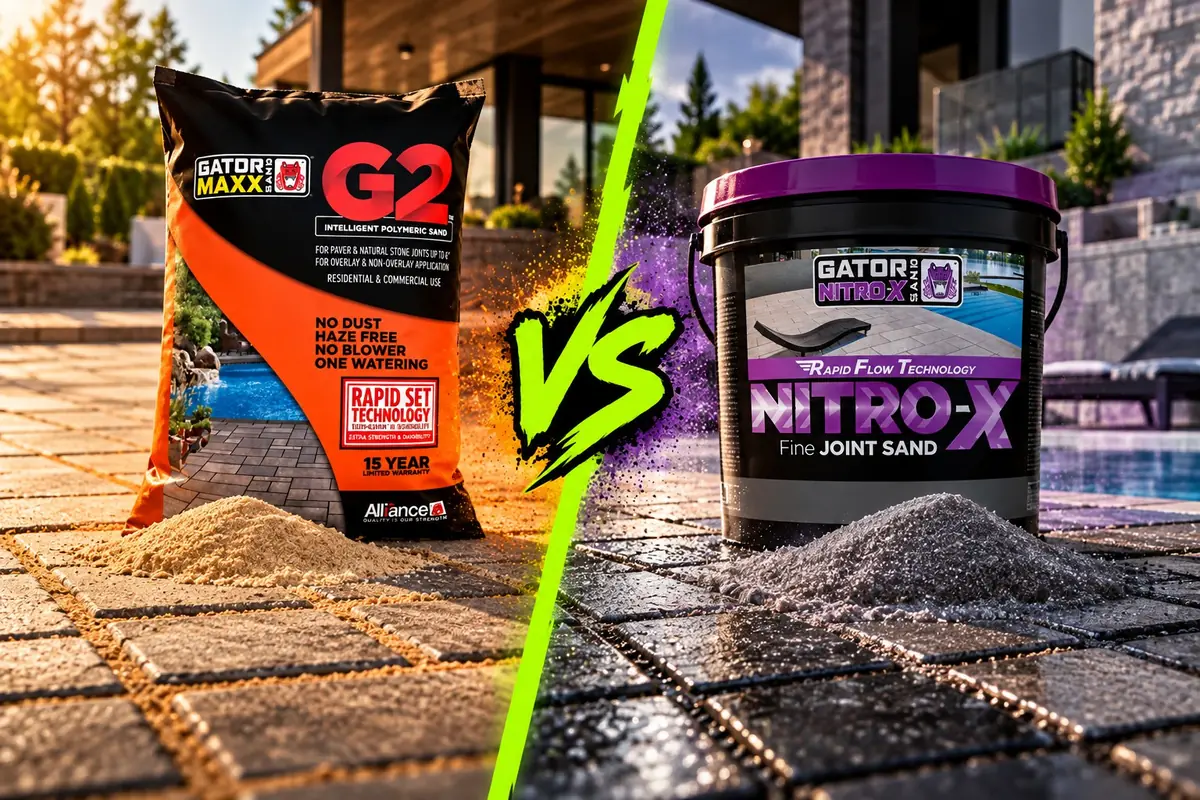
The joints between your pavers do more than fill gaps. They lock the pavers together, keep weeds and ants out, and decide what happens to rain and meltwater. For years the standard choice has been polymeric sand. A newer option, resin-based joint sand, solves several of its weak points, especially with today’s larger pavers and in a climate like ours.
What is polymeric sand?
Polymeric sand is fine sand mixed with polymer binders. It’s swept dry into the joints, compacted, then misted with water. The water activates the binders and, as the sand dries, it hardens into a firm joint that resists washout, weeds and insects.
It works well when it’s installed carefully, but it’s demanding. The pavers must be completely dry, no rain can fall for a set window after watering, and it needs temperatures above freezing to set. Too much water leaves a white haze on the pavers; too little leaves a weak crust. It also relies on a base that drains, because joints that stay damp never fully harden.
What is resin-based joint sand?
Resin-based joint sand comes pre-mixed with a resin binder. Instead of being activated by water, it cures when exposed to air, hardening from the top down over roughly a day. It’s spread wet, worked into the joints, and the surface is rinsed clean. No compaction is needed once the pavers are set.
Once cured, the joint stays firm but permeable: water passes through it into the base instead of running across the surface. We use Alliance Gator Nitro-X, a resin-based joint sand, on our paver projects.
Side by side
| Polymeric sand | Resin-based sand | |
|---|---|---|
| How it hardens | Activated by water, hardens as it dries | Cures on contact with air |
| Weather at install | Needs dry pavers and no rain for a set time | Can go in on damp days, very rain-resistant once placed |
| Water | Joints mostly shed water | Water drains through the joints into the base |
| Joint width | Works in narrow joints | Needs wider joints, about 5 mm or more |
| Haze risk | White haze if over- or under-watered | Surface rinsed clean during install |
| Pressure washing | Can soften or wash out joints | Safe once fully cured, after about four weeks |
| Finish and colours | Limited colours | Wider colour range, joints can be tooled smooth |
| Cost | Lower | Higher |
Why permeable joints matter in Montréal
Water that can’t get through the joints runs across the surface and collects in low spots, where it freezes into ice patches in winter. Water that sits under a solid joint, with nowhere to go, can freeze in place and push pavers up.
Resin-based joints let rain and snowmelt pass straight down. Paired with an open-graded stone base, the whole system drains from the surface to the soil, which is exactly what you want through dozens of freeze-thaw cycles a winter. Read more about why an open-graded base stops heaving and settling.
A better fit for modern pavers
Today’s larger-format pavers and slabs, like much of the Techo-Bloc range we install, are often laid with slightly wider joints. That suits resin-based sand, which needs joints of about 5 mm or more. Its wider colour range also lets the joints match or contrast the pavers for a cleaner, more finished look.
Weeds, ants and cleaning
Both products are designed to stop weeds and ants when they’re installed properly. The difference shows up over time. Polymeric joints can soften and wash out under a pressure washer. Fully cured resin joints can be pressure washed without damage, which makes spring clean-up easier.
Because resin joints stay permeable, dirt and organic debris can slowly build up on the surface of the joint. A light rinse or pressure wash every so often keeps them draining freely.
When polymeric sand still makes sense
- Tight joints narrower than about 5 mm, where resin can’t fill properly
- Commercial areas or heavy vehicle traffic beyond a normal home driveway
- Smaller repairs where matching the existing joints matters
- Projects where the lowest material cost is the priority
What we use, and why
On our paver projects we use Alliance Gator Nitro-X resin-based joint sand over a 1/8 in clear-stone bed and an open-graded stone base. It lets water drain through every layer, holds up to our winters, and gives a clean finish on modern pavers. It’s also part of why we can put a 3-year guarantee on the jointing material and levelling of every paver project.
In the few cases where resin sand isn’t the right fit, like very tight joints or when a client prefers polymeric, we use Alliance Gator G2 Maxx polymeric sand. That’s about 1 project in 20.
Frequently asked questions
What is the difference between polymeric sand and resin sand?
Polymeric sand is activated with water and hardens as it dries. Resin-based sand comes pre-mixed and cures when exposed to air. Resin sand can be installed in damp weather, stays permeable so water drains through, and can be pressure washed once cured.
Is resin-based joint sand worth the extra cost?
For most residential patios, walkways and driveways with modern pavers, yes. It drains better, is less sensitive to weather during installation and holds up well to cleaning. Polymeric sand still makes sense for very tight joints or heavy commercial traffic.
Can you pressure wash resin joint sand?
Yes, once it has fully cured, usually after about four weeks. Polymeric sand joints are more likely to soften or wash out under a pressure washer.
Does resin joint sand stop weeds and ants?
Yes. Like polymeric sand, it forms a firm joint that resists weeds and ants when it’s installed correctly.
Why is my polymeric sand hazy or washing out?
White haze usually comes from over-watering during installation or from salts in the pavers. Washout usually means the sand never fully hardened, often because of rain too soon after installation or a base that stays damp.
More guides: pavers vs. asphalt driveways and artificial turf vs. grass.
Planning a patio, walkway or driveway?
We’ll walk you through paver and joint options on site and show you your project in 3D. The consultation is free.